
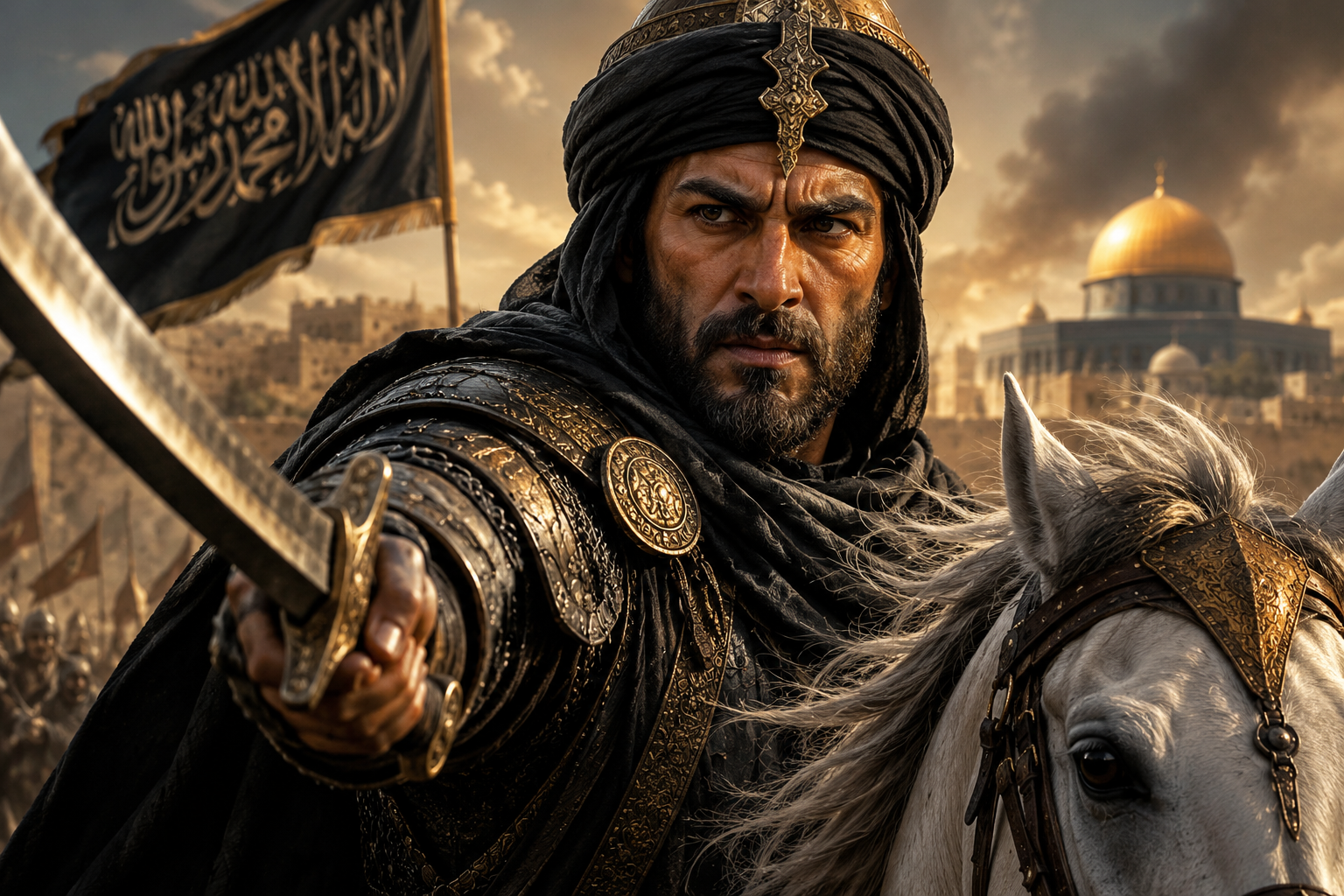
On a hot July morning in 1187, two armies faced one another in the hills of Galilee.
On one side stood the army of the Kingdom of Jerusalem, supported by forces from the Crusader states.
On the other stood the army of Salahuddin Ayyubi, the Sultan who had spent years bringing much of the Muslim Near East under his control.
What happened next would change the history of the Crusades.
The battle became known as the Battle of Hattin or the Horns of Hattin.
It was not simply a clash between two armies.
It was the result of years of political conflict, military campaigns, broken truces, strategic planning and competing claims over the Holy Land.
And the most important question is:
How did Salahuddin Ayyubi defeat such a large Crusader army?
The answer lies not in one dramatic moment, but in a combination of strategy, geography, water, mobility and the decisions made before the armies even reached Hattin.
The World Before Hattin
To understand Hattin, we have to go back almost a century.
In 1099, the First Crusade captured Jerusalem and established Crusader states across parts of the Levant.
The Kingdom of Jerusalem became the most important of these states.
For decades, Muslim and Crusader rulers fought, negotiated treaties and sometimes cooperated with one another.
The political situation was never simple.
There were rival Muslim rulers.
There were rival Crusader factions.
There were changing alliances.
And there were constant struggles over cities, fortresses and trade routes.
By the second half of the 12th century, however, a new Muslim leader was emerging.
His name was Salahuddin Yusuf ibn Ayyub.
In the West, he became known as Saladin.
Who Was Salahuddin Ayyubi?
Salahuddin was born around 1137 and eventually became Sultan of Egypt and Syria.
His rise was not immediate.
He spent years fighting, negotiating and building political alliances.
One of his most important achievements was bringing previously divided Muslim territories under a much more unified political and military structure.
By the 1180s, he controlled Egypt and had extended his authority across major parts of Syria and northern Mesopotamia.
This mattered enormously.
Because before Salahuddin could seriously challenge the Crusader states, he needed something more important than a large army.
He needed unity behind that army.
The Crusader States Were Still Powerful
It would be a mistake to imagine the Crusader states in 1187 as weak or insignificant.
The Kingdom of Jerusalem controlled important cities, castles and strategic territories.
Its armies included heavily armoured knights who had developed considerable military experience.
The Crusader states also had powerful fortifications.
But they had a serious problem.
Their population and manpower were limited.
Maintaining soldiers across a network of castles and cities was difficult.
If the main field army was destroyed, many settlements could become vulnerable.
And that is exactly what happened at Hattin.
The Truce Begins to Collapse
By the 1180s, relations between Salahuddin and the Kingdom of Jerusalem had become increasingly unstable.
One of the most controversial figures was Raynald of Châtillon.
Raynald had repeatedly attacked Muslim territories and trade routes.
In 1187, his actions against a Muslim caravan became a major trigger for the final confrontation.
Salahuddin regarded the attack as a violation of the existing truce.
The political situation deteriorated rapidly.
And Salahuddin began preparing for a major campaign.
The stage was set.
The Crusader Army Mobilizes
The Kingdom of Jerusalem’s king, Guy of Lusignan, gathered a huge field army.
The decision was dangerous.
The Crusader army had to leave fortified positions and move into open territory.
According to historical estimates, the Crusader force numbered more than 16,000 men, including around 1,300 mounted knights, although exact medieval troop numbers are debated.
This was not simply a small expedition.
It represented a major mobilization of the military power of the Crusader kingdom.
But there was a problem.
The army needed water.
And Salahuddin knew it.
Tiberias: The Trap Begins
Salahuddin’s forces were besieging Tiberias, a strategically important city near the Sea of Galilee.
The Crusader army was positioned around Sepphoris, roughly west of Tiberias.
The Crusaders now faced a difficult decision.
Should they remain where they were, close to water and supplies?
Or should they march toward Tiberias to relieve the city?
The decision was made to move.
And that decision placed the Crusader army on a difficult route through hot, dry terrain.
Salahuddin had achieved something extremely important.
He was getting the Crusader army to move where he wanted it.
The March Toward Hattin
On 3 July 1187, the Crusader army began moving toward Tiberias.
The journey was difficult.
The summer heat was intense.
Water supplies were limited.
The terrain was challenging.
And Salahuddin’s forces were nearby.
But instead of immediately launching one enormous frontal attack, Muslim cavalry repeatedly harassed the Crusader column.
Mounted archers attacked.
Then withdrew.
Then attacked again.
The Crusaders were forced to continue marching while under pressure.
This was not simply about killing soldiers.
It was about exhausting the army.
The Battle Was Already Being Won Before the Main Clash
This is one of the most important facts about Hattin.
The decisive moment was not necessarily the final charge.
The battle was being shaped during the march.
Salahuddin’s army used its mobility to keep pressure on the Crusaders.
The Muslim forces were also better positioned around the available water sources.
The Crusader army was becoming increasingly exhausted.
And as the day progressed, the importance of water became enormous.
The battlefield itself was becoming a weapon.
The Horns of Hattin
The location became known as the Horns of Hattin because of two prominent volcanic hills rising above the surrounding landscape.
The Crusader army eventually reached this area.
But it was already in serious difficulty.
The troops were tired.
Water was scarce.
The army’s formation was under pressure.
And Salahuddin’s forces surrounded them.
Historical accounts differ on some details of exactly how the final movements unfolded, but the central strategic picture is clear:
The Crusaders had been drawn away from their secure water sources and were now fighting under severe environmental and tactical pressure.
Fire in the Dry Grass
One of the most famous details associated with Hattin is the use of fire.
Muslim troops reportedly set fire to dry vegetation around the Crusader army.
Combined with the heat, dust and lack of water, this created an extremely difficult environment.
Whether every later detail of the traditional account should be accepted literally is debated, but contemporary and later historical accounts consistently emphasize the Crusaders’ severe thirst and exhaustion.
The important point is not the fire alone.
It is the combination of environmental pressure and military harassment.
The Crusader Formation Breaks
The Crusader army had traditionally relied heavily on disciplined formations.
Infantry could provide protection for the cavalry.
The knights could then launch powerful charges.
But at Hattin, the army was becoming disorganized.
The infantry was no longer providing the same level of protection.
The soldiers were exhausted.
The cavalry struggled to operate effectively.
And Salahuddin’s mounted forces continued to attack from multiple directions.
The Crusader army was losing cohesion.
Once that happened, its heavy cavalry advantage became much less useful.
The Final Clash
On 4 July 1187, the battle reached its decisive stage.
The Crusader army attempted to break through the surrounding Muslim forces.
But the formation had already deteriorated.
Some Crusader troops managed to escape.
Others were captured.
The main army was effectively destroyed as a fighting force.
The defeat was catastrophic for the Kingdom of Jerusalem.
Salahuddin had achieved one of the most significant military victories of the medieval period.
What Happened to King Guy?
King Guy of Lusignan was captured.
He was among the high-ranking prisoners taken after the battle.
Other important Crusader nobles were also captured.
The fate of prisoners varied.
Some high-ranking nobles were eventually ransomed.
Others were killed.
Ordinary captured soldiers faced much harsher treatment, including enslavement.
This is important because the popular image of medieval warfare can sometimes hide the reality of what happened to prisoners after major battles.
Hattin was not a clean or bloodless victory.
It was a devastating medieval battlefield defeat.
What Happened to Raynald of Châtillon?
Raynald of Châtillon was also captured.
According to historical accounts, Salahuddin had long regarded Raynald as an especially dangerous enemy because of his attacks on Muslim territories and caravans.
Raynald was executed after the battle.
The precise details surrounding the execution appear differently across historical narratives, but his death is one of the most well-known episodes associated with Hattin.
The True Cross Was Captured
Another major psychological blow to the Crusaders was the capture of what Christians regarded as the True Cross.
The relic had been carried with the Crusader army.
Its loss at Hattin had enormous symbolic importance.
For medieval Christian Europe, this was not simply the loss of another military object.
It was a profound religious and political shock.
The defeat therefore carried consequences far beyond the battlefield.
Why Was Hattin So Important?
Because the Crusader army had been the main field force protecting the Kingdom of Jerusalem.
Once that army was destroyed, many cities and fortresses were suddenly exposed.
Salahuddin now had an opportunity.
And he moved quickly.
Over the following months, major Crusader positions fell.
Acre.
Tiberias.
Nazareth.
Jaffa.
And eventually…
Jerusalem.
The Road to Jerusalem
Hattin took place in July.
Jerusalem fell to Salahuddin in October.
The speed of this transformation was extraordinary.
The defeat at Hattin had removed much of the Kingdom of Jerusalem’s ability to fight a large field battle.
Salahuddin could now concentrate on capturing strategically important cities and, ultimately, the Holy City.
On 2 October 1187, Jerusalem surrendered to Salahuddin.
The city had been under Crusader rule since 1099.
Its return to Muslim rule became one of the defining moments of Salahuddin’s career.
Did Salahuddin Really Defeat the Crusaders Alone?
This is where the popular legend needs some correction.
Salahuddin was the central commander.
But the victory was not achieved by one man alone.
His army contained different groups of soldiers from territories under his rule, including cavalry, mounted archers and other troops.
His commanders played important roles.
And the victory depended on years of political consolidation before the battle.
The Hattin victory was therefore the result of an organized military system, not simply one man’s personal bravery.
Was the Battle Won Because of Superior Numbers?
Numbers alone do not explain Hattin.
Historical estimates vary.
Salahuddin’s army was probably larger than the Crusader army, but medieval troop numbers are difficult to establish with precision.
More importantly, Salahuddin had several advantages:
- Greater mobility
- Large numbers of mounted troops
- Control of water sources
- Knowledge of the terrain
- Continuous harassment
- A Crusader army moving under pressure
- Severe heat and thirst
- Loss of Crusader formation and cohesion
The battlefield therefore favored Salahuddin’s method of warfare.
The Genius of the Strategy
The most important lesson from Hattin is that Salahuddin did not simply wait for a giant clash.
He shaped the conditions of the battle.
He pressured the Crusaders.
He forced them to move.
He attacked their march.
He exploited their thirst.
He used mobile cavalry.
And he waited until the enemy’s formation had weakened.
Then came the decisive engagement.
In military terms, this is much more interesting than simply saying:
“Salahuddin had a bigger army.”
The battle demonstrates how logistics and terrain can become as important as weapons.
The Biggest Mistake of the Crusaders
The Crusader leadership faced an extremely difficult situation.
Tiberias was under siege.
The decision to march toward it placed the army on a route where water was scarce.
Once the army committed itself to the march, retreat became increasingly difficult.
This does not mean the Crusaders were simply foolish.
They were responding to a genuine military crisis.
But Salahuddin successfully turned that crisis against them.
The Crusaders had to choose between two dangerous options.
Stay in place and risk losing Tiberias.
Or march across difficult terrain and face Salahuddin’s army.
They chose the second.
And Hattin followed.
Hattin Was More Than a Battle
The consequences went far beyond the battlefield.
The defeat dramatically weakened the Crusader states.
Jerusalem was captured.
The political map of the Levant changed.
And Europe responded with another major military expedition:
The Third Crusade.
Among its most famous leaders was Richard I of England, known as Richard the Lionheart.
The conflict between Salahuddin and Richard would become one of the most famous rivalries of the medieval world.
But even Richard’s campaigns did not restore Jerusalem to Crusader control.
The Myth of the Perfect Hero
Over centuries, Salahuddin became a legendary figure.
Muslim historians and later traditions celebrated his role in restoring Jerusalem.
European writers also developed a complex image of him, sometimes portraying him as a worthy and honorable opponent.
But historians must separate the historical Salahuddin from later romanticized stories.
He was a medieval ruler.
He fought wars.
He ordered executions.
He captured cities.
He used diplomacy.
He negotiated.
He made strategic calculations.
And he also became an important symbol whose reputation grew long after his death.
The real historical figure is more complicated—and therefore more fascinating—than the perfect hero of legend.
What Is the Truth Behind Hattin?
So what really happened at Hattin?
It was not magic.
It was not simply luck.
And it was not one dramatic sword fight.
The Battle of Hattin was the culmination of years of political and military preparation.
Salahuddin had spent years consolidating power.
The Crusader states were politically divided.
A truce had broken down.
The Crusader army left its secure position.
The march exposed the army to heat and thirst.
Salahuddin’s cavalry kept pressure on the column.
The Crusader formation eventually collapsed.
And on 4 July 1187, the Kingdom of Jerusalem’s main field army was defeated.
The consequences were enormous.
Jerusalem fell only months later.
And the Third Crusade was launched in response.
Why Hattin Still Matters
More than eight centuries later, Hattin remains one of the most studied battles of the Crusades.
Not simply because Salahuddin won.
But because the battle demonstrates a timeless principle of warfare:
An army can be defeated before the final clash begins.
Water.
Food.
Terrain.
Morale.
Movement.
Leadership.
Logistics.
All of these can decide a battle.
At Hattin, Salahuddin understood that the battlefield was not just the place where armies met.
The battlefield began long before the armies arrived.
Final Conclusion
The Battle of Hattin was one of the decisive turning points of the Crusades.
Salahuddin Ayyubi did not defeat the Crusaders through a single heroic charge.
His victory came after years of political consolidation, military preparation and strategic planning.
On the other side, the Kingdom of Jerusalem committed its main field army to a difficult march toward Tiberias.
The army was exposed to heat, thirst and continuous attacks.
By the time the final confrontation occurred, the Crusaders were already in a desperate position.
Hattin destroyed the main Crusader field army.
Jerusalem followed.
And the medieval world changed.
But perhaps the most important lesson is not simply that Salahuddin won.
It is how he won.
He understood his enemy.
He understood the land.
He understood logistics.
And most importantly…
He understood that sometimes the greatest battle is decided before the first sword is drawn.
That was the truth behind Hattin.


Leave a Reply