
Heracleion: The Egyptian City That Disappeared Beneath the Sea
For centuries, Heracleion existed almost like a ghost in ancient history.
Ancient writers referred to a major Egyptian port known as Thonis, while Greek traditions remembered a city called Heracleion. But eventually, the city disappeared from the surface of the world.
There were no towering ruins like those of Giza.
No massive temples standing above the desert.
No obvious remains that could tell modern explorers where the city had gone.
Instead, the remains of this once-important port were hidden beneath the waters of the Mediterranean Sea.
Then, underwater archaeologists began finding something extraordinary.
Statues. Temples. Coins. Ceremonial objects. Shipwrecks. Anchors. Jewelry. And thousands of other archaeological remains.
A lost city was slowly emerging from the sea.
But Heracleion was more than a mysterious sunken settlement.
It was once one of the most important gateways connecting Ancient Egypt with the Mediterranean world.
And its discovery is changing what we know about Egypt’s ancient trade, religion and coastal cities.
Where Was Heracleion?
Heracleion was located in the western Nile Delta, near the Canopic branch of the Nile and the Mediterranean coast.
Its strategic location was extremely important.
Ships arriving from the Mediterranean could reach Egypt through this region before continuing deeper into the Nile network.
That made the city a natural meeting point between different worlds.
Egyptian merchants could exchange goods with traders arriving from Greece and other parts of the Mediterranean.
The city therefore stood at a crossroads of commerce, religion and culture.
Today, much of that landscape lies underwater.
A Gateway to Ancient Egypt
Imagine approaching Egypt thousands of years ago.
Instead of an airport or modern harbor, your journey begins on the Mediterranean.
A trading ship approaches the Nile Delta.
Around the harbor are ships from different regions.
Merchants are unloading cargo.
Goods are being transported toward the Nile.
Temples rise above the city.
Religious ceremonies fill the streets.
This was the world of Heracleion.
The city became particularly important because of its position at the entrance to Egypt.
Before the rise of Alexandria, Heracleion played a major role in controlling maritime access to the Nile Delta.
Its harbor connected Egypt with the wider Mediterranean trading network.
Goods and people could move between Egypt and foreign lands through this gateway.
What Did Heracleion Trade?
One of the most fascinating aspects of Heracleion is its connection to international trade.
Archaeological discoveries provide evidence of a city deeply connected with the Mediterranean world.
Ships arrived carrying foreign goods.
Egyptian products moved outward.
Merchants, sailors and travelers passed through the port.
The archaeological remains discovered underwater include coins, weights, ceramics and other objects that help researchers reconstruct the city’s economic life.
This makes Heracleion important not simply as a lost city, but as evidence of how interconnected the ancient Mediterranean had already become.
Egypt was not isolated.
It was part of a huge network of trade stretching across the ancient world.
The Temple at the Heart of the City
But Heracleion wasn’t only about commerce.
Religion was central to life in Ancient Egypt.
At Heracleion, archaeologists discovered the remains of an enormous temple complex associated with Amun-Gereb, a form of the Egyptian god Amun.
The temple appears to have been an important religious center.
And its location was significant.
According to archaeological evidence, major ceremonies connected with the Egyptian royal tradition took place in the city.
The remains of enormous statues and religious artifacts provide a glimpse into the scale and importance of its sacred landscape.
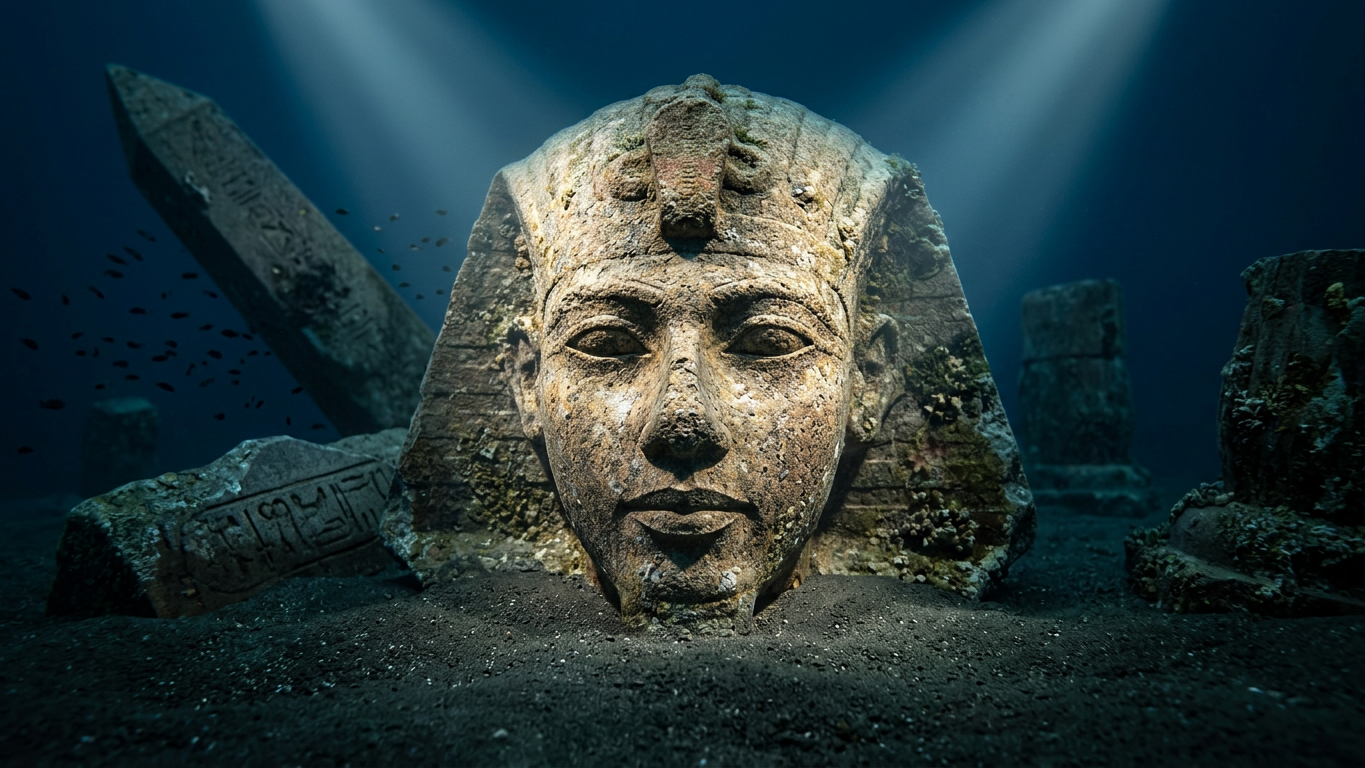
Among the discoveries were colossal statues representing Egyptian deities and royal figures.
Some of these sculptures are several meters high.
Imagine seeing these monuments when they were still standing above the city.
Now imagine them lying beneath the sea.
A City Filled With Giant Statues
Perhaps the most spectacular discoveries at Heracleion are its enormous stone statues.
Underwater archaeologists found colossal figures representing Egyptian gods and rulers.
Some statues were discovered broken and buried beneath layers of underwater sediment.
Others remained remarkably well preserved.
These discoveries provide a visual connection to a city that had almost completely vanished from the surface.
Among the most striking discoveries are monumental representations of figures connected with the religious world of Ancient Egypt.
Their presence demonstrates that Heracleion possessed a monumental religious landscape comparable in ambition to other major Egyptian centers.
But there was another discovery that revealed something even more important.
The city was also a place of ships.
Hundreds of Objects Beneath the Water
Underwater archaeology at Heracleion has revealed an astonishing variety of objects.
Researchers have recovered:
- Stone statues
- Gold jewelry
- Coins
- Ceremonial objects
- Pottery
- Anchors
- Ship remains
- Bronze artifacts
- Weights
- Religious inscriptions
- Architectural fragments
Each object tells part of the story.
A coin can reveal economic connections.
A ceramic vessel can indicate trade.
An anchor can reveal maritime activity.
A religious object can reveal the beliefs of the people who lived there.
And when thousands of objects are found together, archaeologists can begin reconstructing an entire city.
Why Did Heracleion Sink?
This is where the story becomes even more mysterious.
Heracleion did not simply vanish overnight because of one clearly documented event.
Researchers have identified several natural processes that affected the region.
The Nile Delta is a landscape of soft sediments.
Over time, geological changes, rising sea levels, earthquakes and soil instability could have affected coastal settlements.
In Heracleion’s case, parts of the city appear to have experienced land subsidence.
As the ground became unstable and sank, water gradually overwhelmed parts of the settlement.
Earthquakes may also have contributed to the process.
The result was catastrophic for a city built along a low-lying coastal environment.
Buildings collapsed.
Heavy statues fell.
Ships were abandoned or destroyed.
And eventually, the Mediterranean covered much of the ancient city.
The city that had once welcomed ships from across the Mediterranean became an underwater archaeological site.
From Powerful Port to Lost City
By the time Alexandria became the dominant Mediterranean port of Egypt, Heracleion’s importance had already begun to decline.
Alexandria was founded in the 4th century BCE and eventually became one of the greatest cities of the ancient world.
Heracleion’s role changed.
Then nature transformed the city even further.
Parts of the settlement sank beneath the water.
Over centuries, sediment covered the remains.
The memory of the city gradually faded.
Ancient references survived.
But the physical city itself was gone.
Was Heracleion Really Forgotten?
For a long time, historians knew of the name Thonis from ancient sources.
Greek sources referred to Heracleion.
This created a historical puzzle.
Were Thonis and Heracleion the same city?
Archaeological discoveries eventually provided powerful evidence that the names referred to the same major port, understood through Egyptian and Greek cultural contexts.
But locating the physical remains was another challenge.
For centuries, nobody knew exactly where the city was.
That changed with modern underwater archaeology.
The Discovery Beneath the Mediterranean
The rediscovery of Heracleion is closely associated with underwater archaeologist Franck Goddio and the European Institute of Underwater Archaeology, working with Egyptian authorities and archaeologists.
Instead of searching for a visible ruin, researchers had to explore the seabed.
That meant using sophisticated underwater surveying techniques to map the submerged landscape.
Magnetometers, sonar and other technologies helped identify anomalies beneath the seabed.
Divers could then investigate selected areas.
What they discovered was extraordinary.
The seabed was not simply filled with scattered objects.
It contained the remains of an ancient urban landscape.
The Ships That Tell the Story
Among the most fascinating archaeological discoveries are the remains of ancient ships.
Heracleion’s location made maritime activity central to its existence.
Archaeologists have identified numerous shipwrecks and ship-related remains in the submerged city.
These vessels can tell researchers how ancient people traveled, transported goods and operated within the Nile Delta and Mediterranean.
A shipwreck is more than a broken vessel.
It can preserve clues about the cargo it carried.
It can reveal construction techniques.
It can provide evidence of maritime technology.
And it can show how people interacted with the sea.
At Heracleion, the ships help connect the city’s religious and commercial worlds.
Gold, Coins and Everyday Life
Not everything discovered at Heracleion belonged to temples.
Archaeologists also found objects connected with everyday life and economic activity.
Coins provide evidence of monetary systems and political connections.
Gold jewelry reveals wealth and craftsmanship.
Weights can provide clues about commercial transactions.
Pottery can help identify trade routes and cultural connections.
Together, these artifacts transform Heracleion from an abstract historical name into a real human city.
A city where people worked.
Where merchants negotiated.
Where sailors arrived.
Where priests performed rituals.
Where families lived.
And where political and religious power intersected with international trade.
Heracleion and the Egyptian Religious World
Religion may have been the most important part of Heracleion’s identity.
The city was closely connected with the worship of Egyptian gods.
Large temple structures and monumental statues demonstrate the importance of religious institutions.
One particularly significant religious connection was the worship of Amun.
The temple complex was not simply a place of prayer.
In ancient Egyptian society, temples could also be major economic and political institutions.
They controlled land, resources and labor.
They were centers of administration and religious authority.
That means the remains of Heracleion’s temple can tell us much more than what people believed.
They can help explain how the city itself was organized.
The Ceremony That Connected Egypt and the Sea
Heracleion also appears to have played a role in important religious ceremonies associated with the Egyptian royal and religious traditions.
Its position near the Mediterranean and Nile made it particularly significant.
The city stood at the point where the world of Egypt met the sea.
That symbolic role may have strengthened its religious importance.
The harbor wasn’t simply an economic gateway.
It was also part of a sacred landscape.
This combination of trade, politics and religion helps explain why Heracleion became such an important city.
Why the Discovery Matters
The discovery of Heracleion changed more than a map.
It changed our understanding of ancient Egypt’s relationship with the Mediterranean.
For decades, popular images of Ancient Egypt focused on pyramids, pharaohs and desert temples.
But Heracleion reveals another Egypt.
An Egypt of:
ships.
merchants.
foreign travelers.
international trade.
ports.
religious ceremonies.
And a coastline constantly shaped by natural forces.
The city demonstrates how deeply connected Ancient Egypt was to the wider Mediterranean world.
A Lost City Still Being Explored
Heracleion has been discovered, but its story is far from complete.
Underwater archaeology is slow.
The seabed preserves enormous quantities of archaeological material, but every object must be carefully documented.
Researchers must understand where an artifact was found, what surrounds it and how it relates to the wider archaeological landscape.
That means the discovery of Heracleion isn’t one dramatic moment.
It is an ongoing process.
Every excavation can reveal another piece of the city’s history.
And some of its secrets may still be waiting beneath the sediment.
What Happened to the People of Heracleion?
One of the biggest questions remains deeply human.
What happened to the people who lived there?
The archaeological evidence indicates that the city experienced major environmental changes and episodes of destruction.
Buildings collapsed.
The landscape changed.
Parts of the settlement became submerged.
But the archaeological record does not provide a single simple story in which everyone disappeared at once.
Some people may have left before the final submergence.
Others may have remained as the environment deteriorated.
The city’s decline was likely connected to a combination of environmental, geological and historical changes.
That complexity is exactly what makes Heracleion so fascinating.
Heracleion vs. Atlantis
Because Heracleion was a major city that disappeared beneath the sea, comparisons with Atlantis are almost inevitable.
But the two stories should not be confused.
Atlantis belongs to the philosophical writings of Plato.
Heracleion, by contrast, is an archaeological site supported by physical remains.
Researchers have recovered thousands of artifacts from the submerged city.
So Heracleion does not need a mythical explanation.
Its real story is already extraordinary.
A major Egyptian port existed.
It flourished.
It connected Egypt with the Mediterranean.
And eventually, much of it disappeared beneath the sea.
The Real Mystery of Heracleion
The most fascinating question may not be:
“How did an entire city disappear?”
The deeper question is:
“How could a city this important almost disappear from human memory?”
For centuries, Heracleion existed primarily through fragments of ancient texts.
Its physical remains were hidden underwater.
Then modern archaeology brought those remains back into the historical record.
Today, every statue, ship, coin and temple fragment helps reconstruct a civilization that once seemed lost forever.
Heracleion: Ancient Egypt’s Lost Trade Empire
Heracleion was more than a sunken city.
It was a gateway.
A place where Egypt met the Mediterranean.
A place where merchants exchanged goods, sailors crossed waters, priests served the gods and rulers projected power.
Its disappearance reminds us that ancient cities were not always destroyed by armies.
Sometimes nature itself could reshape the map.
A coastline could move.
The ground could sink.
Water could rise.
And a city that once dominated a harbor could eventually become invisible beneath the sea.
But archaeology has a remarkable ability to reverse that disappearance.
Today, Heracleion is once again part of history.
Not because the city returned to the surface…
but because its story was recovered from beneath the waves.
Watch the Full Heracleion Documentary
Want to see the underwater ruins, colossal statues, ancient ships and archaeological discoveries for yourself?
Watch the full National Geo History documentary and explore the lost Egyptian city of Heracleion in cinematic detail.
Subscribe to National Geo History for more documentaries about Ancient Egypt, lost cities, ancient civilizations, archaeology and historical mysteries.
Final Thoughts
The discovery of Heracleion gives us a rare look at an Ancient Egypt that existed beyond the pyramids.
It reveals a civilization connected to the sea.
A civilization that traded across the Mediterranean.
A civilization whose cities could rise to extraordinary importance—and later disappear beneath the water.
And beneath the Mediterranean, the remains of Heracleion continue to tell that story.
The city disappeared.
The evidence did not.
Related Topics
Explore more National Geo History documentaries about:
- Ancient Egypt
- Lost Cities
- Sunken Cities
- Underwater Archaeology
- Ancient Civilizations
- Egyptian Pharaohs
- Archaeological Discoveries
- Historical Mysteries
- Ancient Trade Routes
- Lost Cities of the Ancient World




Leave a Reply