

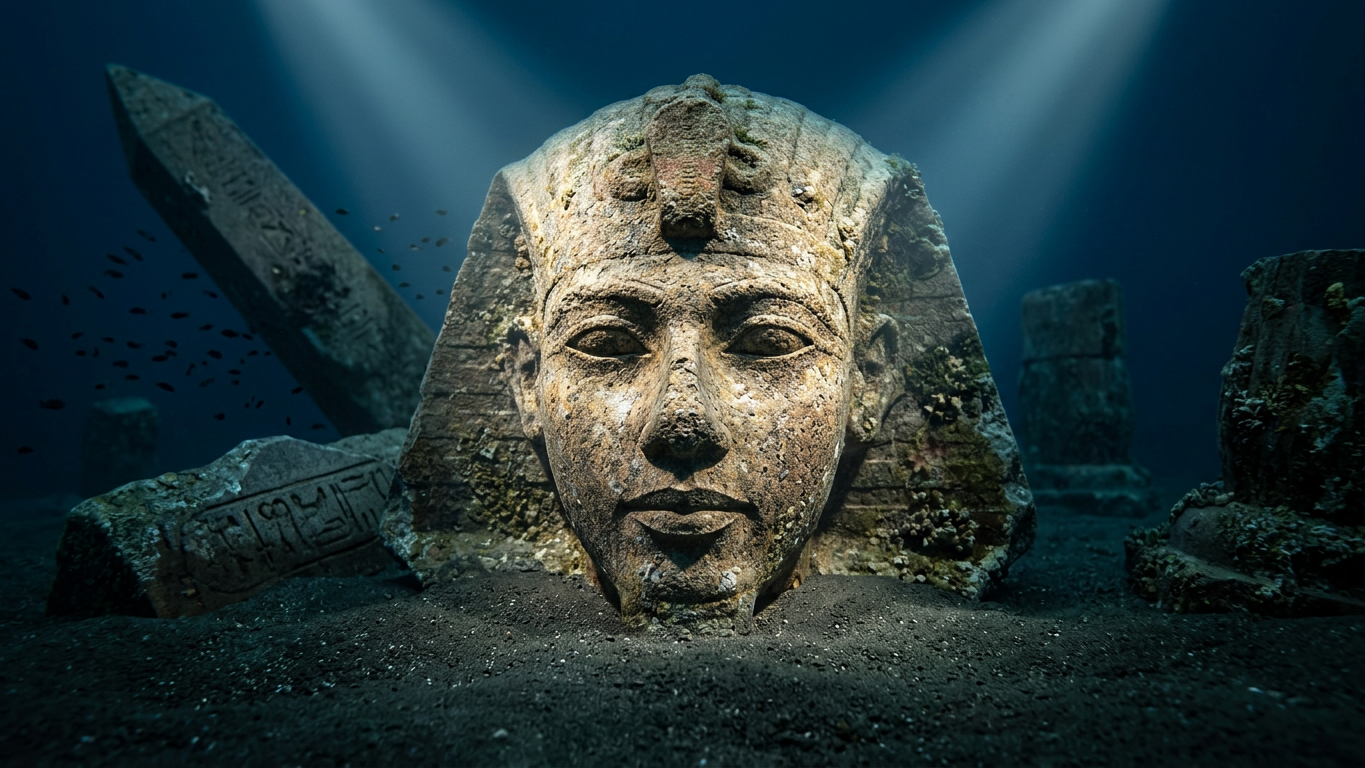
Ancient Egypt produced some of history’s most famous rulers.
Khufu.
Hatshepsut.
Thutmose III.
Akhenaten.
Tutankhamun.
Ramesses II.
Their names are associated with enormous monuments, powerful armies, religious transformation, and one of the world’s greatest civilizations.
But absolute power had another side.
Behind the temples, pyramids, golden statues, and royal celebrations were stories of warfare, political purges, religious persecution, forced labor, dynastic struggles, destruction of monuments, and rulers who used the full power of the Egyptian state to protect their throne.
So who were the most controversial and destructive rulers of Ancient Egypt?
And were they really the “worst Pharaohs in history”?
The answer is more complicated than the title suggests.
There was no ancient Egyptian list of “good” and “bad” pharaohs. Much of what we know comes from royal inscriptions, later historians, religious texts, archaeological evidence, and records written by people with their own political interests.
So rather than treating this as an absolute ranking, this documentary explores 10 Egyptian rulers whose reigns contain some of the darkest, most controversial, or most destructive episodes in the history of Ancient Egypt.
1. Khufu — The Pharaoh Behind the Great Pyramid
Few names are more famous in Egyptian history than Khufu, the ruler who commissioned the Great Pyramid of Giza.
For thousands of years, the Great Pyramid has represented the extraordinary organizational power of the Egyptian state.
But ancient sources sometimes portrayed Khufu very differently.
Later Greek writers described him as a harsh ruler who oppressed his people and even forced members of his own family into prostitution to finance the pyramid project.
That story is dramatic.
But historians have good reasons to be cautious.
Modern archaeological evidence does not support the old popular image of millions of slaves being forced to build the pyramids.
Workers lived in organized settlements near Giza, and evidence indicates that the pyramid workforce included skilled laborers and organized crews.
The Great Pyramid therefore tells us something about the enormous power of Khufu’s government — but it does not automatically prove that Khufu was a brutal tyrant.
His reputation is a perfect example of how ancient stories can become darker over time.
2. Pepi II — The Mysterious Long-Reigning King
Pepi II is traditionally associated with one of the longest reigns in Egyptian history.
He ruled during the Sixth Dynasty, a period that eventually ended with the decline of the Old Kingdom.
Later traditions portray Pepi II in unusual and sometimes disturbing ways.
One famous story claims that the king ordered a naked servant covered with honey to distract flies so that the insects would not bother the Pharaoh.
But there is a major problem.
This story comes from a much later tradition and cannot be treated as straightforward historical evidence.
What can be said with greater confidence is that Egypt experienced increasing political fragmentation toward the end of the Old Kingdom.
Whether Pepi II personally caused Egypt’s decline remains debated.
The fall of the Old Kingdom was almost certainly more complicated than the actions of one ruler.
3. Senusret III — The Warrior King
Senusret III was one of the most powerful rulers of the Middle Kingdom.
He expanded Egyptian control into Nubia and established a series of fortifications along the southern frontier.
His military campaigns were extremely important to Egyptian power.
But Egyptian inscriptions celebrated these campaigns from the perspective of the conqueror.
Nubian populations experienced the expansion of Egyptian military power very differently.
Senusret III’s monuments repeatedly emphasized the strength of the Egyptian state and the dangers posed by its enemies.
His reign demonstrates an important reality about ancient empires:
The same ruler can be remembered as a great protector by one population and as a conqueror by another.
4. Thutmose III — The Napoleon of Ancient Egypt
Thutmose III is often celebrated as one of Egypt’s greatest military rulers.
During his reign, Egypt expanded its influence across the Levant.
He conducted numerous military campaigns and famously fought the Battle of Megiddo.
His victories were recorded on temple walls.
But military success inevitably came with destruction and death.
Egyptian armies campaigned against cities and kingdoms that resisted Egyptian control.
Thutmose III’s inscriptions naturally emphasize his victories rather than the suffering experienced by defeated populations.
This does not make him uniquely cruel by the standards of his period.
It does, however, remind us that the greatness of an ancient empire was often built through military power.
5. Amenhotep II — The Pharaoh Who Boasted of Violence
Amenhotep II inherited an enormous Egyptian empire.
Like many New Kingdom rulers, he presented himself as a powerful warrior.
His inscriptions describe military campaigns and acts of violence against Egypt’s enemies.
Royal propaganda was designed to demonstrate that the Pharaoh was strong enough to protect Egypt and defeat anyone who challenged him.
This is important because ancient Egyptian royal inscriptions were not modern neutral historical reports.
They were political statements.
A Pharaoh wanted his subjects — and the gods — to see him as victorious.
Amenhotep II’s records therefore provide valuable historical evidence, but they must be read with an understanding of royal propaganda.
6. Akhenaten — The Pharaoh Who Changed Egypt’s Religion
Then came one of the most controversial rulers in Egyptian history:
Akhenaten.
His reign transformed Egypt.
Akhenaten elevated the Aten, the solar disk, to unprecedented religious importance and reduced the traditional prominence of many other Egyptian gods.
He abandoned traditional royal centers and established a new capital at Akhetaten, modern Amarna.
Temples and artistic traditions changed dramatically.
For a society whose political and religious system was deeply interconnected, this was an enormous transformation.
After Akhenaten’s death, later rulers restored traditional religious practices.
His name and images were deliberately erased or damaged in many places, and his reign was treated by later Egyptians as something to be forgotten.
Was Akhenaten a religious revolutionary?
A dangerous extremist?
Or simply a Pharaoh attempting to reshape Egyptian society according to his beliefs?
The surviving evidence allows historians to study his actions, but his motivations remain much harder to determine.
7. Horemheb — The Pharaoh Who Erased a Dynasty
After the chaos following Akhenaten’s religious revolution, Horemheb became Pharaoh.
He presented himself as the ruler who restored order.
Traditional religion was restored.
The old priesthood regained importance.
And the Amarna period was increasingly condemned.
Horemheb also participated in the systematic removal of the memory of Akhenaten and some of his successors from monuments and official history.
Names were removed.
Statues were destroyed or altered.
Monuments were reused.
This was more than simple vandalism.
It was a political attempt to control historical memory.
The message was clear:
The Amarna rulers were not supposed to be remembered as legitimate Pharaohs.
8. Ramesses II — The Pharaoh of Propaganda
Ramesses II is one of the most famous Pharaohs who ever lived.
He ruled for approximately 67 years and filled Egypt with monuments celebrating his reign.
His name appears at temples across the country.
But Ramesses also understood something extremely important:
Power could be preserved through storytelling.
His most famous military achievement was the Battle of Kadesh against the Hittites.
Ramesses’ inscriptions presented the battle as a tremendous Egyptian victory.
However, the wider historical evidence suggests the battle was far more complicated than the royal propaganda implied.
Eventually, Egypt and the Hittite Empire concluded a peace treaty.
This does not make Ramesses a uniquely “bad” Pharaoh.
Instead, his reign demonstrates how ancient rulers could use monuments and inscriptions to construct an official version of history.
The Pharaoh controlled not only armies and temples.
He also controlled the story that future generations would hear.
9. Psamtik II — The Pharaoh Who Tried to Erase Kushite Power
During the 26th Dynasty, Egypt once again became a major regional power.
Psamtik II ruled from approximately 595 to 589 BCE.
His reign included a major military campaign against the Kingdom of Kush.
The campaign was not only military.
Psamtik II appears to have deliberately targeted the monuments and memory of earlier Kushite rulers in southern Egypt.
Names were removed from monuments.
Statues and buildings were damaged or altered.
This appears to have been part of an attempt to eliminate the visible legacy of Kushite power from Egyptian territory.
This is one of the clearest examples of a recurring theme in ancient politics:
To control the present, rulers sometimes tried to control the past.
10. Cambyses II — The Persian Conqueror of Egypt
There is an important historical problem with including Cambyses II in a list called “Pharaohs.”
He was not an Egyptian-born Pharaoh.
He was the Persian king who conquered Egypt in 525 BCE and ruled it as part of the Achaemenid Empire.
But he is often included in discussions of Egypt’s foreign rulers because his reign became associated with one of the darkest reputations in Egyptian history.
The Greek historian Herodotus portrayed Cambyses as cruel, sacrilegious, and unstable.
He claimed that Cambyses killed the sacred Apis bull and committed other acts against Egyptian religious traditions.
But modern historians have challenged several of these claims.
Contemporary evidence does not support all of Herodotus’ accusations, and other Egyptian evidence presents a more complicated picture of Cambyses’ relationship with Egyptian religion.
This makes Cambyses one of the best examples of why ancient history must be investigated carefully.
The king’s reputation may have been shaped partly by political and cultural hostility between Egyptians, Persians, and later Greek writers.
So was Cambyses a monster?
The surviving evidence does not allow such a simple conclusion.
The Dark Side of Pharaoh Power
Looking across these rulers, one pattern becomes clear.
Ancient Egyptian kings possessed extraordinary political power.
They commanded armies.
They controlled enormous resources.
They commissioned temples and monuments.
They influenced religious institutions.
And they could shape the historical memory of their own reigns.
But the same system that produced the pyramids and magnificent temples could also produce:
War.
Political repression.
Religious conflict.
Monument destruction.
Forced state projects.
Dynastic violence.
Historical erasure.
This is the paradox of absolute monarchy.
The Pharaoh was expected to maintain Ma’at — the Egyptian concept of order, balance, and justice.
But maintaining that order could involve enormous military and political power.
Were These Really the “Worst” Pharaohs?
This is where the story becomes complicated.
Ancient Egypt lasted for more than 3,000 years.
Hundreds of rulers occupied the Egyptian throne.
Our evidence is also uneven.
Some Pharaohs left enormous monuments.
Others are known from only a few inscriptions.
Some negative stories were written centuries after the events they describe.
And royal inscriptions were often propaganda.
Therefore, it is impossible to create a completely objective list of the “10 worst Pharaohs.”
Instead, these rulers are better understood as examples of controversial, violent, politically disruptive, or heavily mythologized periods in Egyptian history.
The Pharaohs Were Not Gods in the Modern Sense
The Pharaoh was closely connected with the gods and was responsible for maintaining cosmic order.
This religious authority gave the monarchy extraordinary legitimacy.
But Pharaohs were still human rulers.
They fought wars.
They made political decisions.
They made mistakes.
They faced rebellions.
They competed with powerful officials and religious institutions.
And after their deaths, later rulers could attempt to rewrite their legacies.
That is why Egyptian history is not simply a story of perfect divine kings.
It is a story of human beings operating inside one of the ancient world’s most powerful political systems.
What Happened to the Pharaohs Who Lost Power?
One of the most fascinating aspects of Egyptian history is what happened after a dynasty collapsed.
A new ruler could deliberately distance himself from the previous regime.
Names could disappear from monuments.
Statues could be destroyed.
Buildings could be dismantled.
Religious traditions could be restored.
The official version of history could change.
Akhenaten is perhaps the most dramatic example.
For a period, he stood at the center of Egyptian religious life.
After his death, later rulers attempted to erase much of his memory.
Yet thousands of years later, archaeologists rediscovered the evidence.
The Pharaoh who was supposed to be forgotten became one of the most famous rulers in Egyptian history.
Absolute Power Never Lasts Forever
The story of these controversial rulers reveals something bigger than Ancient Egypt.
Power can build monuments that survive for thousands of years.
But power can also disappear.
Dynasties collapse.
Cities are abandoned.
Religions change.
Enemies become forgotten.
And rulers who once commanded entire armies can eventually become nothing more than a name carved into stone.
The Pharaohs wanted their names to live forever.
In some cases, they succeeded.
But not always in the way they intended.
Final Thoughts
Ancient Egypt produced some of humanity’s greatest monuments.
But behind those monuments was a political system built around extraordinary royal power.
Some rulers expanded Egypt through war.
Some transformed its religion.
Some attempted to erase their predecessors.
Some used monumental propaganda to glorify their victories.
And some gained terrible reputations from sources written long after their deaths.
The phrase “10 Worst Pharaohs” makes for a dramatic title.
But the historical reality is much more fascinating.
Because when we look beyond the legends, we discover that Ancient Egypt was not a simple story of good kings and bad kings.
It was a civilization of ambition, religion, warfare, political struggle, technological achievement, and human complexity.
And perhaps the most important lesson is this:
The Pharaoh could control Egypt.
But no Pharaoh could control history forever.
Explore More Ancient Egypt
Discover more National Geo History documentaries about Ancient Egypt, Pharaohs, pyramids, mummies, temples, ancient civilizations, archaeology, and historical mysteries.
Explore the rulers who built monuments that still stand today — and uncover the stories hidden behind their legends.
Subscribe to National Geo History and continue exploring the ancient world.




Leave a Reply